Fleet Preview: Hyundai Tucson
The best-selling Tucson is back with a bold new design, progressive electrified powertrains, next-generation connectivity and enhanced comfort.

Martyn Collins

Exterior
The current Hyundai Tucson might have been on sale for more than five years, but its distinctive styling – one of the first designs developed under its ‘Sensuous Sportiness’ look – still stands out and looks fresh, in our opinion.
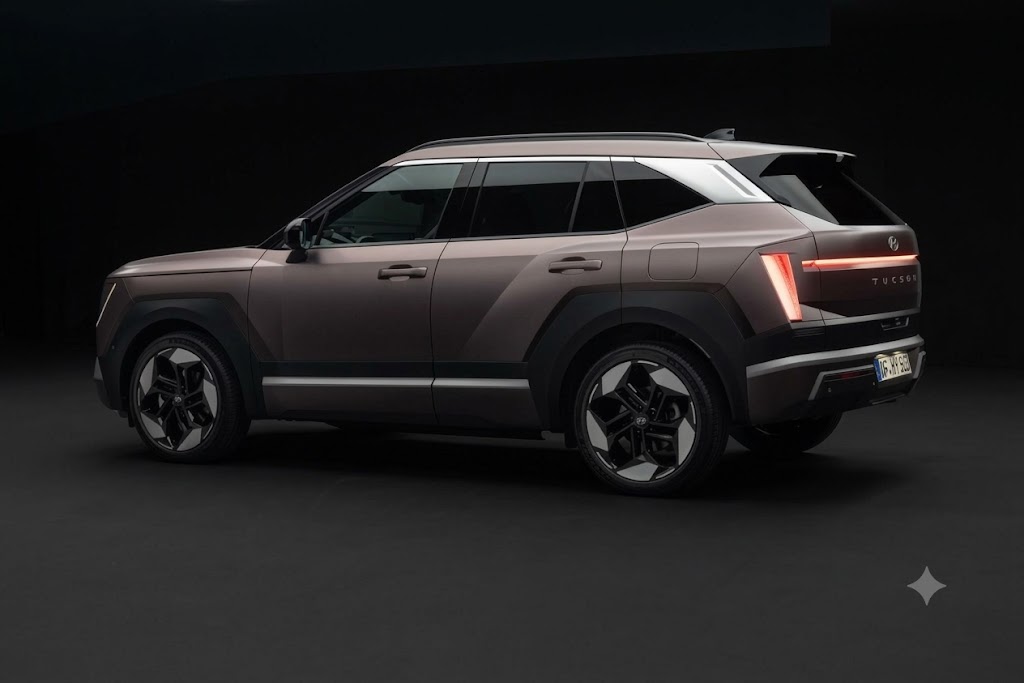
Well, it’s all change for the next-generation Tucson, and Corporate Car has been given early access. ‘Sensuous Sportiness’ has been replaced by an ‘Art of Steel’ design philosophy this time around. This can be seen through its pronounced muscular wings, sharp body surfaces and crisp lines, which are designed to express the Tucson’s inherent strength and tension in steel.

The Tucson has grown, for starters. It’s now 4,400mm long, 1,905mm wide and 1,685mm high, and this Hyundai now sits on a 2,785mm wheelbase. The extra length is most obvious at the front and rear of the new car.
At the front, the Tesla-like H-Edge lighting combines indirect central illumination with edge lighting, which is designed to emphasise the Tucson’s horizontal proportions and create a wider appearance.
The rear of the new Tucson is where, in our opinion, you’ll find its most identifiable design feature – the sculptural Prism Rear Lamps. Depending on specification, Micro Pixel Lighting (MPL) uses 25,600 individual LED pixels for precisely controlled beam patterns, as well as welcome and farewell animations.
Overall, the Tucson’s increased dimensions give it a strong and confident SUV stance. With distinctive lighting graphics, the new Tucson is easily recognisable – much like the current car.

Interior
The new Tucson introduces Hyundai’s ‘Curve of Upholstery’ approach, which the company claims creates a ‘Furnished Space’, combining soft, voluminous surfaces with practical storage and intuitive controls. This can be seen in the two-layer dashboard design, with a crash pad separating the clean upper visual area from the deep, open storage tray below. There is also cushioning across the crash pad, doors and centre-console armrest.
Hyundai is also debuting an ‘Eyes on the Road, Hands on the Wheel’ philosophy with this Tucson’s interior. As a result, the slim 9.9in digital instrument display sits right at the top of the dashboard, within the driver’s natural field of view, while physical buttons below the central touchscreen give direct access to frequently used functions. The gear selector moves to the steering column, like the all-electric Ioniq 9, freeing up additional centre-console space.
The new Hyundai Tucson has grown 60mm in length and is 30mm wider, yet having sat in the back of the new car, it didn’t feel any more spacious than the old car. However, there’s now a flexible 40:20:40 split-folding rear bench with a 150mm sliding function – although we understand this isn’t available on plug-in hybrid models.
Another Tucson interior highlight is the introduction of Hyundai’s latest infotainment system. Called Pleos Connect, it is based on the Android Automotive operating system. The system integrates vehicle functions, infotainment, compatible apps and connected services, with the Gleo AI voice assistant able to access live data from the internet. Meanwhile, over-the-air software updates allow selected systems and infotainment functions to evolve remotely. Pleos Connect will be available with 12.9in and 17in displays in the new Tucson.

Powertrains
The new Tucson is offered with a broad choice of electrified and non-electrified powertrains. The range includes a 1.6 T-GDI petrol engine, a 234hp hybrid (HEV) and a 284hp plug-in hybrid (PHEV), giving fleets a choice of powertrain concepts suited to different driving requirements.
A key innovation is HEV Stay Mode, which allows selected comfort and convenience functions – including climate control, audio and device charging – to remain available while the combustion engine is switched off. This provides a quieter, EV-like environment during stops and breaks.
The Tucson PHEV, which arrives after launch, combines a 1.6-litre turbocharged petrol engine with a plug-in hybrid system to deliver up to 284hp. Its 17.1kWh battery provides an estimated electric-only range of up to 50 miles with 17in wheels, subject to final homologation, while the 7.2kW onboard charger supports AC charging.
Equipment
UK specification details have not been released.
Safety
All new Tucson models have a comprehensive suite of Hyundai SmartSense technologies, plus an enhanced body structure with seven airbags and a range of advanced driver-assistance and monitoring functions.
One of the cleverest is Memory Reverse Assist, which records a vehicle’s path at speeds of up to 19mph and can subsequently control the steering while reversing along the recorded route. Another is ‘Ground View Monitor’, which gives drivers an enhanced view of the area around and beneath the vehicle, while ‘Trailer Reverse Assist’ supports steering when manoeuvring with a trailer.

Cost
Official pricing for the new Hyundai Tucson has not yet been announced, but prices are expected to be similar to those of the outgoing model when it’s launched next year.
Share this
Featured Posts


Explore Topics