Aion UT Review
Latest Chinese challenger to the rapidly growing EV B-segment majors on space, range and premium features.

Martyn Collins
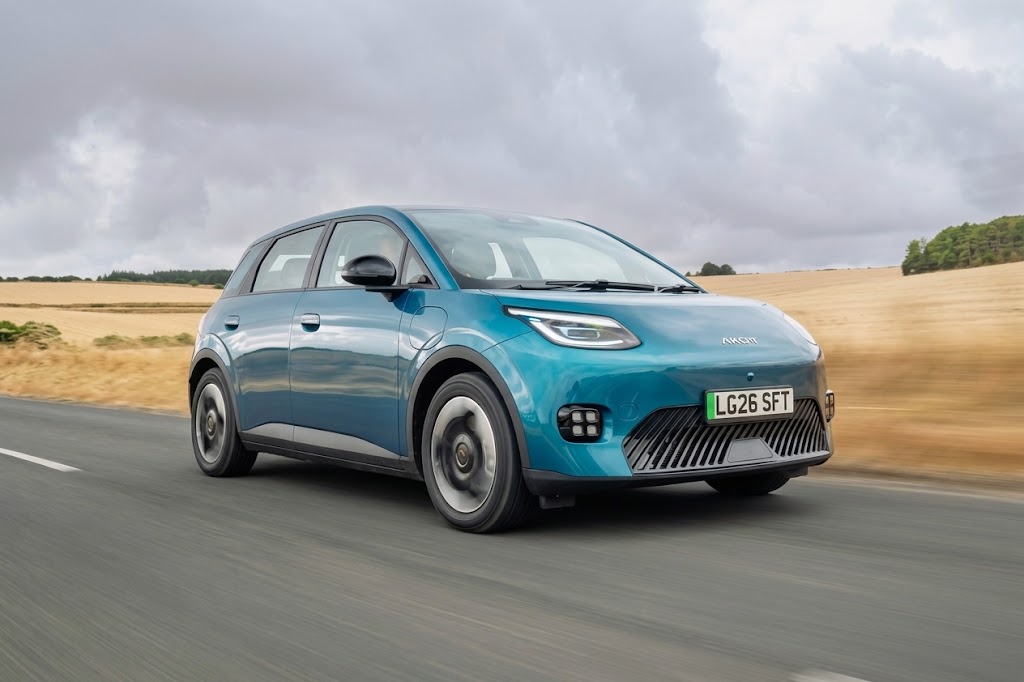
Sister model, the C-segment SUV, the ‘V’ has only been on sale for just over four months, but that hasn’t stopped new-to-the-UK Chinese manufacturer Aion attacking another key sector, with the UT B-segment hatchback.
Aion is a sub-brand of the GAC Group, a major state-owned Chinese car manufacturer, previously best known for its joint ventures with Toyota and Honda. Despite still being relatively unknown in the UK, Aion has big plans for growth, with 100 UK dealers expected to be trading by 2030, plus five new Aion models.
So, what about the UT? Like the Aion V, it’s built on GAC’s AEP (Architecture Electric Platform) 3.0, a dedicated, skateboard-style EV architecture. The UT is offered with a large 60kWh battery, equalling a class-leading 268 miles of range.
With its 400V architecture and 87kW charging capacity, it can go from 10 to 80% charge in as little as 32 minutes. It also has a standard-fit heat pump.
Design and technology
The UT was styled at Aion’s Milan design studio for Europe. With its curvy, compact shape, sleek surfacing and LED headlights styled like an owl’s eyes, it doesn’t look like its rivals, which we think is a good thing. It is also slippery, with a 0.32 coefficient figure.
However, the UT’s design is very colour-sensitive. Our Shadow Black test car appeared to lose some of the design details and, in our opinion, is the least successful colour available.
Thanks to dimensions almost big enough for the class above (4,270mm long, 1,850mm wide and 1,575mm tall), the Aion UT is impressively spacious front and rear, with plenty of headroom, too.
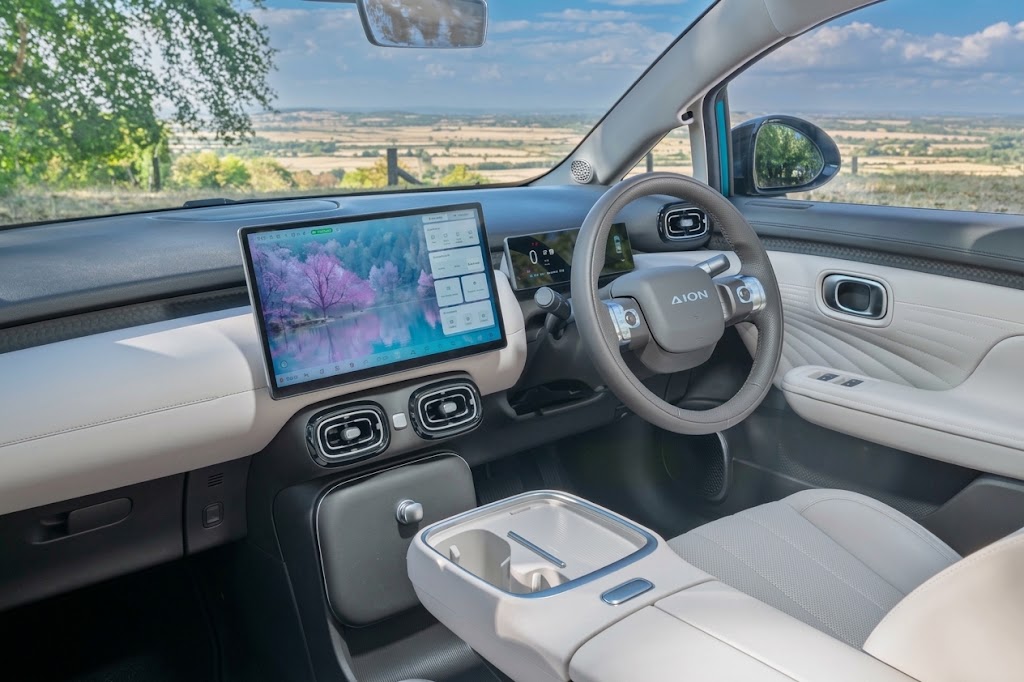
Like the ‘V’, the UT has a European feel to its interior, with a two-tier dash, mixture of finishes and attractive curved stitching on the door panels. Oddly, the hardest finishes are on the tops of the dash and doors, although we were told this was down to the UT’s positioning in the range.
Still, the UT feels solid and well-made, with plenty of stowage in the floating centre console and underneath.
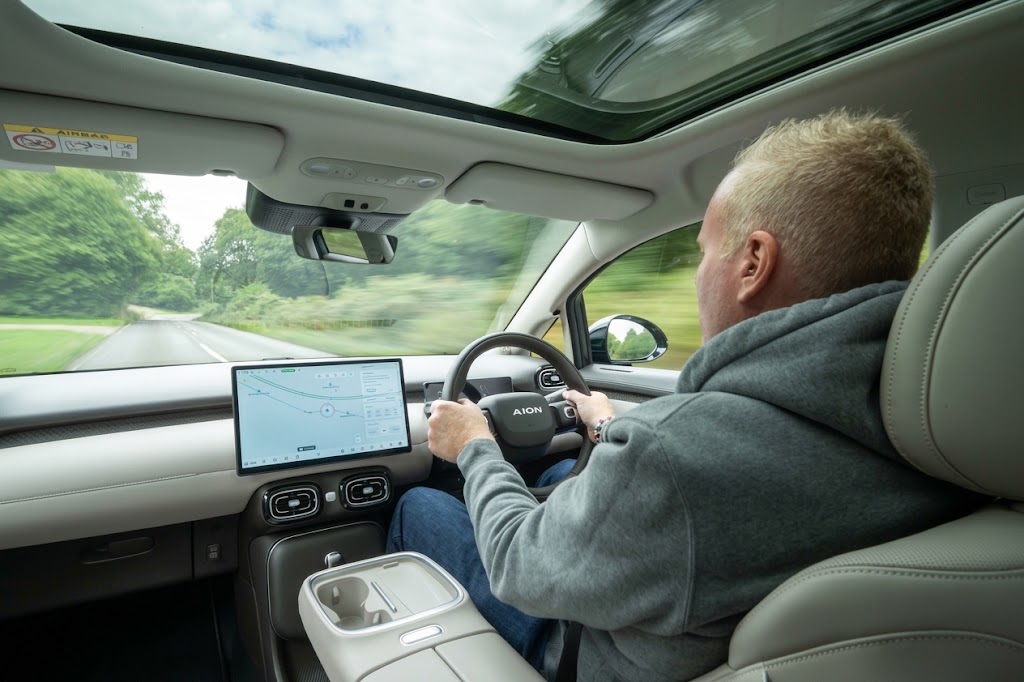
The driving position is tall, the seats are well-padded and trimmed in faux leather. The front pillars are reasonably thin, with small quarter lights, giving decent forward visibility. However, like the Geely EX2, the thicker rear pillars mean the standard 360-degree camera is useful when reversing.
There is an 8.8in driver’s screen, but it’s the 14.6in infotainment screen that controls all the car’s functions. Thankfully, recently used features are grouped alongside the navigation. We much preferred using CarPlay, the infotainment shortcuts are small and the menus too long, making changes difficult on the move.
The Aion UT also has an exhaustive level of standard equipment, including a heated steering wheel and seats, online navigation, LED headlights and rear lights. The £1,200 Premium Pack, which is expected popular with Corporate and Fleet customers, adds a panoramic glass roof, ‘French Cream’ interior trim, power tailgate and wireless phone charger. The 440-litre boot is deep, with a low loading lip.
Drive and performance
With its 60kWh battery, 201hp, 210Nm of torque and 0-62mph time of 7.3 seconds, the Aion UT feels quick off the mark. However, the biggest limitation is the locally made tyres, which, in our opinion, are too keen to spin the power away. The super-light steering and small turning circle make it particularly easy to manoeuvre in town.
Out of town, the lack of steering feel, especially around the straight ahead, is disappointing. The steering weight appears to change on the move, making it hard to place the car and gauge the available grip in corners.
The UT’s ride has been tuned to UK roads, we were told, with different spring and damper rates, plus bump stops. Stiff at low speeds, the UT feels comfortable, composed and capable going faster.
There are ‘Comfort’, ‘Sport’ and ‘Power Save’ modes, but only ‘Sport’ seems to change how the UT drives, with keener throttle response. However, drivers will have to put up with the ‘chirps’, as the Chinese-made tyres struggle to find grip.
Fleets and corporates looking for a small but deceptively spacious, sharp-looking and well-equipped EV, backed by its comprehensive Great 8 warranty, should look closely at the Aion UT. However, Renault’s brilliant 5 E-Tech is available for less, while the still-excellent Fiat Grande Panda is even more affordable. Both rivals are more fun to drive, but offer considerably less interior space or range.
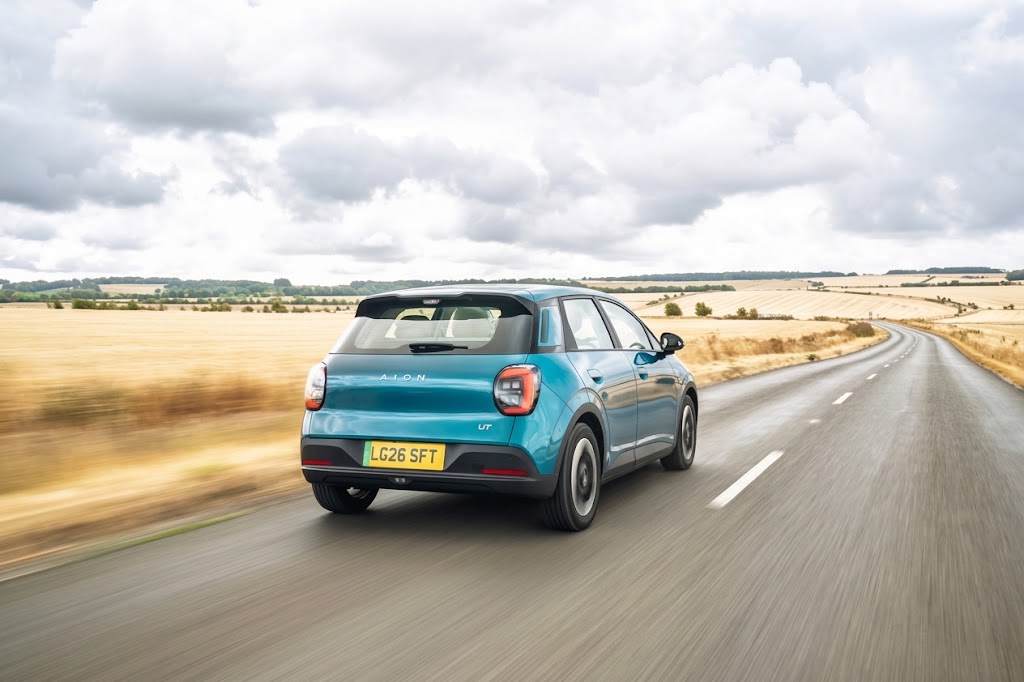
Positive: Well-equipped, long range, impressive warranty gives confidence, spacious and modern interior.
Negative: Not much fun to drive, Chinese tyres sometimes feel overwhelmed, all switchgear is in the infotainment screen.
Standard equipment: 17in alloy wheels, LED head and taillights, body-coloured flush door handles, leatherette upholstery, 14.6in infotainment screen.
Aion UT 60kW Premium Pack
P11D | £30,085 |
|---|---|
Range | 268 miles |
CO₂ (BiK) | 0g/km (4%) |
BiK 20% / 40% a month | £20 / £40 |
Luggage capacity | 440 litres |
Battery / Power | 60kWh / 201hp |
Share this
Featured Posts


Explore Topics